The Future is Insight

The title of this blog works on many levels- it plays off of my belief in hybrids being a critical step towards our future, the fact that introspection and mindful planning are critical to our future, and that the future is literally in sight for those that are willing to see it. Here I chronicle my attempt to Be the Change I wish to see in the world-and to help make that Future a Reality.

Thursday, November 22, 2007

Aquaponics

I took a tour this week that blew my mind and I have been dying for a few spare moments to tell you about it.  A few friends of mine from the fledgling Sustainability NPO we recently founded, Sustain Jefferson , spent a few incredible hours touring Growing Power this past Monday.    Growing Power is an Urban Ag facility that claims to grow enough food for 2000 people on 2 acres.  With a claim like that I was drawn like a moth to flame.  Their website offered some clues to their system-vermiculture, aquaculture, and several greenhouses.  The site filled in the details and inspired me in a way that no other has since I was originally introduced to Permaculture and Bill Mollison.

What excited me most about Permaculture was the sheer common sense of it all.  Taking wastes and turning them into resources to allow you to reap the benefits of both in one integrated system continues to fascinate me  Aquaponics, especially in the uber simple system that Will Allen of Growing Power sets up, fits the bill perfectly.

Aquaponics takes the aqua from aquaculture and ponics from
 hydroponics and melds them with a healthy dose of applied Permaculture.  Aquaculture is the farming of fish in indoors in recirculating water tanks.  The single largest waste from this system is that housing thousands of fish in a closed system fouls the water right quick.  Hydroponics is a system of growing plants in a nutrient water medium, which of course begs the question of where the nutrients come from.

Aquaculture attempts to solve these problems, and routes the waste water from the aquaculture tanks through a hydroponic system to provide the nutrients for the plants, which help to clean the water and significantly reduces the filtration needed.  Even at this level I love the idea.  Growing Power puts this system into overdrive.

What Will Allen and some others are doing is experimenting with what is considered by most to already be an experimental way of raising fish and plants.  First off Will has completely done away with the filtration system.  He has also done away with any commercial feed, preferring instead to grow his own.  See the underlying foundation of Growing Power is worms.

Readers of this blog know that I am a firm believer in Vermiculture as a means to reduce, even recycle, waste and turn out some freaky good fertilizer.  Growing Power does this on an almost industrial scale-using hundreds of bins (pictured) like mine to process literally 1o's of thousands of pounds of  waste into worm castings.  

The other great thing that worms do is, um, breed.  In fact in perfect conditions composting worms will double in population every 6 weeks.  Growing Power uses the immense amount of castings to provide the growing medium for their greenhouse operations and then uses the surplus worms as a significant portion of the feed for his thousands of Tilapia in the aquaculture tanks.
Back to the filtration method.  Growing Power uses plants, specifically water cress, to filter the water.   As with most of the systems at the site, it is simple and uses mostly reused items that are common in an urban environment.  In this case reclaimed sump pumps water from the bottom of the 5' deep tanks to 30' long flats of cress.  The flats are very slightly sloped, and as the water slowly makes it way through the pea gravel bed that serves to anchor the cress roots it is cleaned of virtually all of the excess waste.  Will Allen was not real long as specifics when asked about ratios of cress to Tilapia, he is an instinctive innovator... he just knows it works.   Several PhD types have also toured the facility and are adamant that the system should not work.  Yet, Will adds with one of his huge grins-he has been doing it for 3 years and has only lost one fish.  Time to rewrite the textbooks!

So what gives?  Will Allen (the giant in the blue sweatshirt) is convinced that the few handfuls of worm
castings he adds to the cress flats are the difference.  The castings are chock full of rich living bacteria and fungus cultures, and it is these that Will believes supercharges the cress flats with filtering capability.   After seeing the vibrance and life of his greenhouses, the obvious health of his fish, and the numerous innovation that seemingly turn up at every corner-I believe him.  Heck, that is how wetlands are supposed to work, right?

Anyone who knows me can see where this is going.  Will's newest aquaculture houses are built in simple plastic hoop houses in an attempt to cut costs.  He does a lot of mentoring in the 3rd (and 4th) worlds and is trying to get the system down to its bones.  The last house he took us through was built for $5000 plus labor, and it houses 7000 tilapia and 2500 Lake Perch in addition to 300 sq ft of water cress and several hundred pots of greens and vegetables that were basking in the warm humid air.   The next biggest problem to overcome is how to make it Peak Proof by removing the dependence on the second hand natural gas pool heater he is using.  It will certainly add significantly to the start-up costs, but a combined solar water heating and wind turbine dumping into a heating element after charging a few batteries for lighting seems like a great primary heating system with a propane backup.  This could also be modified to run on methane from a digester.   The owner of the farm I am using to grow my market garden has plans for one already drawn up...  

Looks like I have a winter research project!

It was truly inspiring to see people in the heart of an the poorer parts of Milwaukee making a difference, growing sustainable and nutritious food, and spreading the word about simple commonsense systems that work.  

-Beo

Labels: , , ,

Stumble Upon ToolbarStumble It!

Tuesday, October 09, 2007

The Meaning of the 21st Century

I am currently reading the book and I find it simultaneously riveting, terrifying, angering, and stimulating. Thus far Martin seems to place far too much faith in technology and humanity in general for my liking, but he is much, much better connected to What is Going On, so I am withholding as much judgment as I can. Another good video of Mr. Martin here

If for no other reason than to make your brain sweat, I recommend the book.

Labels: ,

Stumble Upon ToolbarStumble It!

Friday, September 21, 2007

Why we shop at Whole Foods

My Eco Mia puts it best.


I know that Whole Foods is contentious.


Many of you also know that I detest the "Lamers"... those on the Left that spend their energy dragging down those people making real solid changes in thier lives or businesses to make the world a better place because they aren't doing enough. Can we do more? Yes, we can always do more.

But the world will be made a better place by helping and building, not hurting and destroying.


I stand with those who help and are actively Being the Change.

Labels: ,

Stumble Upon ToolbarStumble It!

Wednesday, September 19, 2007

Paying the Mowers

With the land deal made my mind (to no one's surprise) is in hyperdrive. I think I have read half of the ATTRA site in the past several days, worn the pages of my Seeds Savers and Seeds of Change catalogues down to nubs, and have spent an inordinate amount of time drooling over equipment sites that no good can come from like Earth Tools, and others that actually make sense like Scythe Supply. It is that last sight that has tickled my muse this morning.

This 1890 scene was found on the Scythe Supply's site-and is titled "Paying the Mowers". What has me going is that here are a half dozen grown adults receiving their wages for mowing. Someone who knows their way around a scythe can reportedly mow about an acre a day. Now imagine paying in today's wages about $100+ to have each acre of your pasture/orchard/lawn mown. It would be ridiculous, but considering that was the way of things barely 100 years ago it bears thought. With this in mind it is not hard at all to see why rural America is dead or dying-population densities lower than when the Native Americans had the run of the land and the rural youth in full flight to more favorable climes. This flight is redefining our country and forcing the vast majority of our food to be grown by drivers instead of farmers.

I realize I am waxing nostalgic here and glossing over an immense amount of things like cholera, social security, and botox, but there was a time when this country paid just wages for things that mattered-like putting up the winter's hay for the dairy cow-rather than KitchenAid mixers or LCD screens. As Polan and others have made clear to larger society, we currently pay less, as a percentage, for our food than any other culture in history. So not surprisingly we treat that food as a commodity valued by cost alone with hardly any consideration to quality. As a society we will spend weeks agonizing over which digital camera to purchase, but spend little to no time reading the ingredient list of the cereal we feed our children and caring not at all about the farmer that grew the grain, or the workers that packaged it.

This past year I have tasted a sweet new fruit-that of receiving part of my wages from growing food or crafting items (rain barrels) with my own hands. Given that I charge just prices (about 3x the grocery store) for my produce and products, my customers would not be purchasing it if they did not value it, and what it stands for, more. I take great pride in having a neighbor choose my produce to serve in their restaurant or to feed to their family.

Our rural economy was once based on neighbors providing products and services to each other. That interconnectedness bred community and a level of dependence. You paid just prices to the smithy or mill-if they folded who would repair your wagon or allow you to make bread? Why should today be any different? Our family will gladly pay more for local business to keep that business local-be it a bakery, repair shop, hardware store, or famer's market. We have the power of the purse to make our community economies what we value. Given that statement there is palpable irony in the fact that the closest vendor listed in first paragraph is over 400 miles away.

The facts are that the 21st century community will be different than the 19th. Scythe Supply, Seed Savers and others are a critical component to building the future that I desire, and I will support them. But where the local economy still exists I turn to it- my garlic "seed" was purchased locally, we have sought out local coffee roasters, brewers, and cheesemakers, and Wisconsin has some of the finest farmers markets in the Midwest.

I guess I am proposing that we think hard about which mowers we are paying in our lives, and thereby ensure that those mowers will be there come the spring cutting time.

Be the Change.

Labels: , , ,

Stumble Upon ToolbarStumble It!

Sunday, August 19, 2007

Cottage Economy

Less than a year ago we posted on the prospect of us providing rain barrels to fill a niche in the market and a service to Mother Earth. That first full trailer of barrels was so exciting!

Well, alot can happen in a year-and we've come a long way baby!


This past Saturday Mia and I unloaded a semi-trailer load of barrels to the ill masked curiosity of the neighborhood. This was a BIG project-these barrels weigh over 100lbs each. Luckily barrels are designed to move easily (their, well, round) so despite having 4.5 tones of oak to handle we had them unloaded in 30 minutes with the help of the drivers and a simple ramp of 2x4's.
We have also made huge improvements in our production-I am on my third drill (an 8amp Bosh Hammer Drill that will try to snap your arms off if you aren't damn careful-do not ask how I know this) and have upgraded to carbide tipped hole saws and massive auger drills to save time. Mia in her first stab at making the intakes tripled the productivity of that task. So by noon we had the all unloaded, 70 of them in the garage, and 22 built. Of course we can hardly move today, but the accomplishment is impressive. Henry Ford would be proud, and once installed these 22 barrels will account for 40,000 gallons of runoff saved annually-when the batch is completely done by the end of the month it will be closer to 150,000 gallons. Nice.

Labels:

Stumble Upon ToolbarStumble It!

Friday, March 30, 2007

Whose Woods These Are

We live in a Subdivision. There I said it. See, at work I am always talking about the "village"-working on a committee for the "Village", etc. It seems that some people at work had come to believe I lived in a commune of sorts-or at least an EcoVillage-though they know that term only in abstract. One guy actually sad that he was disappointed in me...

And maybe I am disappointed in myself. 3 years ago we had a small 2 acre Farmette picked out-small house that needed some work, but a few outbuildings and enough room for a goat and some chickens. Our Permaculture Paradise. We put money down and sold our house. Then the deal went south in a hurry and we ended up backing out with our house sold with only 6 weeks until closing. In 2 weeks we visited literally every house on more than 1 acre within an hours drive of my job that was even remotely in our price range. They were all terrible. Affordable and nice are mutually exclusive in real estate when you also add "acreage". In fact the last house literally smelled of sewage due to a failed septic field. Time was short and we ended up in a Spec home with immediate occupancy, .5 acres that was cheap, but also literally on the interstate. My back fence is maintained by the DOT. That was 3 years ago.

Since then we have done wonders with the landscaping, been nominated for 2 Village committees and become very involved in the county. We love the town and I have made good friends with the Movers and Shakers in the Sustainability Circles. We are on the cusp of some Big Changes. But as I write this to the north of my window only 200' away is I-94. Pollution aside, the noise is fatiguing in the extreme and planting a Permaculture Paradise seems almost ironic. Sometimes I feel it is fitting to build the new society so close to the trappings of the current. But only sometimes.

So I am always looking for a new place. Always. I have been watching this house for a year in the vain hope that they will take $150k off of it. What the ad doesn't show you is the sloping hillside to the NW, the 2 acres of reseeded prairie, and the additional 7 acre fenced pasture. If anyone wants a kidney for $150k let me know. The home haunts me... why must every home on more than 2 acres have 6 panel oak doors and marble bathrooms?

Then about a month ago this property came up. If it looks plain, that because it is-in every way. The house is nowhere as nice as current one and it faces north with a God-awful solar aspect. But the Ag taxes are uber low, and it has 4 acres and a stream which are also completely undeveloped. It's only outbuilding is a 10x10 shed and there is literally not a fence on the property. But payments would only be $50/wk more than our Spec Home and I am selling more rainbarrels than that right now. Did I mention there are 5 very mature Maples-syrup anyone? It would take about $70k and/or 10 years to get this where I need it: 800' of fencing, a barn, a wood lot, etc. But it is 4 acres of tabula rosa, and would also cut my drive in half making a bike commute more of a reality. Which is good as the Insight would need to go, I would probably trade it for a TDI with 200k+ miles on it for $6000 just to get me to work in the rain or an old CRX HX that gets 50mpg.
Is this the one? Neither Mia or I think so, but The One is always going to be the better part of $.5 million which is ridiculous and out of the question. So we either need to hang tight for another 3 years until we pay off the cars, or settle for a house that is immensely better, but not what we truly want. We both want the next move to be the last for a looooong time-so we will probably wait.
Waiting sucks.

Labels: ,

Stumble Upon ToolbarStumble It!

Get Busy Living, or Get Busy Dying.

Bart and M.E.O.W. have linked to something we all need to Get Real on. The reality is getting so, um, Real that even CNBC is catching on!

I have come to think of Peak Oil and Climate Change as one issue which I loosely call "unsustainability", the answer to which is Sustainability. The root problem is the same-we are using energy waaaaaaaay to fast, behaving irresponsibly, and need to course correct in one generation-probably in one half of a generation before we doom our children to a life of poverty and doom the third world to a life of starvation.

Kerry talked about it and now Edwards is too-we need to hit Sustainability with the same National effort that we used to get on the moon. Screw Mars-if we want to keep from looking like Venus we need to get honest with ourselves, scrap the Hummers and make 300 bicycles each from the recovered steel. Silliness aside, we need to use the energy we have to set ourselves up for a sustainable future. It takes alot of energy to make PV cells or even Tulikivi stoves. Time to get busy living.

Be the Change!

Labels: ,

Stumble Upon ToolbarStumble It!

Monday, February 26, 2007

"What Can I Do?"

Being Eco Aware in a Fortune 500 company can be interesting. Some of it is great-everyone wants a test drive in your hybrid, but it can also get weird when they want to feel the texture of your organic hemp shirt. Last week in a lull during a meeting in a peer’s office while he took another call I filled the gap by sketching a rough diagram of The Funnel on his dry erase board and as he finished his call I proceeded to regale him with a 90 second version of my deep concern about the results of our current rampant consumerism and its effect on the population limits of our Earth mixing in various elements of ideas such as ecological footprint, Peak Oil, the effects of the melting of the Himalayan glaciers on water availability in India and China, etc. to such an extent that the overall effect was to stun my peer into silence. The Green Bug rears its head at odd times.

Last Friday one of the other supervisors was in that office and my buddy, who has left the diagram up, threw him under the bus by asking me to explain the “funnel” to him. After the inevitable stunned silence he asked me what that means for us. I explained my belief that if it gets that bad-the 1st world will be somewhat protected by our affluence-i.e. in the Depression there was not rampant starvation, just rampant poverty- but for the 3rd and 4th worlds they would not have such luxuries-water and food shortages could be acute with horrifying results given their population levels. He answered with the only real ethical and logical response: “What can I do?”

I was amazed to find that I couldn’t immediately answer. Being short of words is almost unheard of, but after working myself that deep into the Doom and Gloom, changing a few bulbs to CFL’s didn’t seem even remotely enough to offset water shortages on a continent wide scale. I gave it quick thought that centered on a few macro level changes that called for more of a change in mindset than tweaking how you light your kitchen which is my typical answer when a friend asks for a way to live a little greener.

Buy Less After talking so much about the rampant energy consumption, pollution and water shortages in China and India I feel strongly that exporting our pollution and resource use is an immoral act. It takes a lot of energy and water to make a Mattel Hot Wheel in China while at the same time pushing uncontrolled urbanization that is further eroding that region’s ability to feed itself. We cannot be sustainable until we learn to live more frugally. Cutting consumption impacts everything. It cuts environmental degradation from resource appropriation, cuts energy consumption and industrial pollution from unregulated manufacturing, and frees up household money for more sustainable practices that unfortunately can cost more initially while offering long term savings.

Buy Local If we are to survive post Peak Oil and remain flexible enough to roll with the punches of our new self made climate we need to recreate village/regional economies. There is more patriotism to Buying American than in keeping Harley afloat. Here in Wisconsin it isn’t always easy to find local foods and goods year round, but by purchasing as close to home as possible we drive a local economy that encourages artisan skills that will be essential as we are forced to switch from a resource intensive economy and revert to a more knowledge based one. Factor in the massive resource and pollution savings of cutting several thousand miles of transportation off your goods and it’s a no brainer.

Conserve Energy This is usually where I start my Eco Evangelism. I have even made inroads with some die hard neo cons… energy is expensive and even if you don’t believe in Peak Oil or Climate Change, money is a powerful persuader. I figure we are saving $6-8k annually compared to where we were before going green. On a more sustainable level, due to the massive energy losses in transmission lines for electricity or in shipping oil half way around the globe, cutting energy use at the source pays back immense dividends in resource and pollution savings. Hybrids, CFL’s, programmable thermostats, caulking, etc can have incredible effects. Kick it out another level and factor in the built environment with LEED standards, New Urbanism development, and efficient mass transit and hope becomes a reality. We need that energy to invest in a different production infrastructure and may only have a generation to do it.

Buy Organic I rarely push the health benefits of buying organic. The science can be unconclusive and few want to admit they have been slowing poisoning themselves or their children so it throws up walls for them. Instead I push the undeniable environmental consequences of our current industrial agriculture. We are losing our topsoil to the wind while we poison our groundwater--two resources that we literally cannot live without. Almost more terrifying to me is that with the passing of the current generation of farmers (mean age of over 55) we will be losing untold generations worth of accumulated oral traditions of “organic” farming. Our grandparents learned from their fathers before them how to farm successfully without petroleum. Their children switched to a more industrial model and the majority of young farmers today have never farmed any other way. Anyone who has ever tried to start a garden knows that nature is a firm taskmistress and does not brook mistakes-and even Eliot Coleman can only teach you so much from a book. We need that knowledge to be passed on as it always has-through experience: how to hold a hoe, when to plant in your county, and with those skills to have the seeds that have been painstakingly saved for generations to thrive in that exact farm.

I still firmly believe that coming off too strong will not help give others the impetus to change, but that doesn’t mean that we have the right to shy away from the realities of the logical conclusions of our society’s path. If all you can do is convince your neo con neighbor to buy a CFL then we are several hundred Kwh to the better. But for those that are further along the change curve in accepting reality, giving them real tools to help them reorient their lives is critical if we are to build the amount of grassroots momentum to literally save the world. Hubris got us into this mess, it just might be the only thing to get us out.

Be the change!

Labels: , , , ,

Stumble Upon ToolbarStumble It!

Saturday, February 17, 2007

Sustainability

One of the biggest arguments (discussions?) that I get into at work is that Green is "too expensive" or "bad for business". These arguments often start from associates that think of me as the "treehugger" or "that environmentalist guy". That was a badge I had worn with pride, but that is changing the more involved I am become in systemic change in our Village. Our Smart Growth steering committee is the first really diverse committee that I am participating in. The Green Committee is pretty safe-we're all treehuggers-whereas the Planning Commission which constitutes 75% of the S.G. steering committee has a healthy mix of business people that better matches our village as a whole. At our second meeting this week the "us v them" tone started to creep in at times. As a Village we want to push for some fairly radical changes in planning-especially for rural America-cluster development, biogas generation at the treatment plant, narrower streets, less parking, smaller lots, etc. Any one alone is fairly easy to defend (though the smaller lots will be a stretch), but taken all together at once and walls started popping up. Why?

It would be easy to write the wall builders off as "backward", but that is ridiculous and arrogant, breeding more destructive us v them thinking that is poison to real, holistic change. So I tried a different tactic. Instead I threw out to the group some clarifying points that I feel adamant about and have been absent from traditional Environmentalism:

  • Green is good for growth. Green development creates a sense of place by creating communities that are specific to the locale, plus consumers are educated enough to be willing to pay a premium for Green Homes that are safer for their children and save them real money in energy bills. Developers like the fact (once educated!) that they can achieve the same amount of lots with less expense in infrastructure like roads and sewer due to cluster development.
  • Green is good for Business. Environmentally concerned citizens are legion and in many cases have lots of disposable income. These Green Consumers are passionate about where they "vote" with their dollars-we love to boycott the bad, and will get into a frothing rage defending a corporation or group that has earned our trust. We are willing to pay a significant premium for goods and services that meet our standards. An entire community that supports these issues and earns that trust can become a haven for Green "green".
  • Green is becoming anti "anti". The historical environmental movement loved to protest, was very successful at it and effected significant and lasting change. But in many parts of the 1st world the need to chain ourselves to trees is lessening as our ideas achieve broader acceptance in society. At the same time it was changing the worldview of a nation, the Environmental Movement burned some bridges. Saving the Spotted Owl was a noble quest, but that icon is burned into much of the public consciousness as a time when the treehuggers destroyed hundreds of livelihoods and depressed an entire region of the country-a trade off that doesn't add up for hundreds of thousands of citizens for know the actualities only thru distantly remembered headlines. The new fight-which I prefer to call Sustainability- is much more about finding solutions that are win win. Environmentalists are predominantly left leaning. Followers of Sustainability are eschewing such labels. Everyone Breathes.

This change in my thinking has been coming steadily for some months now. So much so that I bought a new book to further flush out my thoughts. The Sustainability Revolution, by Andres Edwards is now on my armchair stand and is proving to be dead on for where I was heading. Here is how Edwards breaks down Sustainability core beliefs into the 3 (6) "E's" which are virtually identical to The Natural Step's.

Ecology/Environment This "E" is framed by three broad concepts: long term not short term thinking, a focus on the systemic understanding of ecosystems critical importance to human life, and finally the strongly held belief that there are limits to the amount of life that the ecosystems of the Earth can support.

Economy/Employment Here is where Edwards (and the Natural Step) begin to grow beyond the traditional Environmental movement. Sustainability focuses on the critical importance of secure, employment and economies that do not overstretch their ecosystems. There isn't a community on Earth that can be truly sustainable if they cannot meet the needs of their citizens-impoverished Africans will harvest bushmeat and American farmers will turn more and more to industrial agriculture without a viable economic alternative to feed their families and pay their bills. Amory Lovins and Paul Hawkins take this out to a much higher level in their brilliant work, Natural Capitalism.

Equity/Equality Without going all socialist here, the world does not have a resource shortage, it has a distribution problem. Ok, I'll go alittle socialist-moral issues such as famines and homelessness are all the more terrible because they are preventable if we could just redistribute the wealth/resources already in use in our society. Edwards also stresses community building in this "E" recognizing the inherent importance in concern and cooperation with ones neighbor. "At a fundamental level, members of a sustainable community understand that the well being of the individual and the larger community are interdependent." We fight for a win win between the owls and the loggers even if we lose perfection in the process. Winning battles the wrong way can lose us the war.

I align myself much closer to the solution building philosophical framework of Sustainability that is willing to allow some flexibility to attain the greater good-less focus on short term achievements than long term goals. But I will still be proud to be called an Environmentalist-at least until the Eco Spin Dr's can come up with something better than Sustainabilitarianist...

Labels: , ,

Stumble Upon ToolbarStumble It!

Wednesday, January 17, 2007

CFL's-the Gateway Drug to a Greener Future

So I have had cause lately to consider the merits of some of the different paths to Sustainability of late. On the one hand you have the Gee Whiz items like recycled paper towels that save 200,000 trees or CFL bulbs that save the equivalent of 1,000,000 cars worth of emissions. The "do a little, and do a lot" camp. Then there is the simplify movement and their imperatives. Eat Local! Grow your own food! Bike to work! Compost! Still another camp works to tweak the system itself thru Natural Capitalism, the Natural Step, or Green Development in an attempt to have our cake and eat it to. In the Mia/Beo household we are doing most of these in some form or another (less than some on the simplify, perhaps more than others in the system change) and the merits of them all come under fire at times.

The Do a Little camp runs the risk of slacktivism attacks from those that have a more fatalistic, if perhaps truer, view of the future. Saving 1m cars worth of emissions just makes global warming only slightly less ominous if you believe that we already have 100 million too many cars to begin with. Of course these attacks rarely achieve the intended goal of inspiring the budding greenite to actually do more, and are much more likely to have them do nothing by scaring them off, leaving us all worse off.

The Imperative Camp has the virtue of passion on their side and can get wonderfully clicky. Organic gardening really is fun, Farmers Markets are a great way to meet people in your community, and reducing your impact by cutting back pays big dividends in the pocketbook as well as garnering psychological benefits like the aesthetics of old. We really care... look what we've sacrificed for our cause! But we loose the mainstream real fast. Our society has force-fed us a steady Fast Food diet of Entitlement for two generations. Dammit I worked hard and I have earned my 70" LCD TV! Good thing I have my Explorer to take it home in too! Look honey-we're saving money on delivery fees! That change will take time and even the best homemade bread pales in the hypnotic light of the latest techno wonder.

The Tweakers have their work cut out for them, but frankly have the best chance for Real Change in the near term by harnessing the powers of Capitalism-basically using Greed for Green Ends. I don't care what you think of global warming-gas is expensive, and if Wal-Mart can pull of its initiatives and actually save 100's of millions of gallons of gas in the next 5 years that is some serious ching-like $310million a year by 2015. The industrial benefits of efficiency are clear, but legislative changes can have huge effects too. Sweden just might be off oil by 2020 using the Natural Step, and even raising the C.A.F.E. standards by 1mpg would save enough oil to save the ANWAR. In one year (why are we doing this again? Oh right...). Heating entire blocks with the waste heat from the local McDonald's like they do Sweden's Green Zone might not sound sustainable-but it is a hell of a lot better than that heat literally going up in smoke. The obvious downside to this is that if Walmart has 100's of millions of gallons of gas to save it is the pinnacle of unsustainability to begin with...

So which path do we pursue? Well, we are doing them all. Everyone starts somewhere, and we all bought our first CFL at one time. Think of it as a gateway drug to a greener future. But careful there. Just because we have taken the trip into the Imperative Camp doesn't mean everyone is ready yet. One trap that I know we have fallen into is scaring the hell out of people with our passion-they aren't there yet. If all they ever do is buy on CFL-or install the one we gave them -that is one step closer for us all. The Imperative Camp can be dangerous-you get so addicted to cutting back that you can have a break down. Look-we all need to shower and if people are noticing your cutbacks in a personal way you've gone to far ok? I am personally pushing the Tweaking Angle in a big way. I am now a trained study group facilitator in The Natural Step for Communities, and we are making real change in our village with the Green Committee. I believe that the darker future could be real and all the compost I make in my lifetime won't save my children from the fate I foresee. I need to take (alot of) others with me.

But that is the rub. Sustainability can take on a fervency akin to religion. And religion scares off a lot of people or leads to nasty Us v. Them thinking. We will win this fight by being the Good Samaritan quietly practising random acts of kindness, not thru mimicking the nutjob on the corner frothing over his Bible.

Find your path to a more sustainable Future...

Be the Change.

Labels: , ,

Stumble Upon ToolbarStumble It!

Friday, January 12, 2007

StormWater Update

Well the engineering proposal's are in and I have 4 days to read through about 300 pages of what can at times be some pretty technical stuff. For the record I am not an engineer. I have never studied law, and do not know how to implement a utility from the ground up in accordance with state law. So that meant the first 20 pages took me 2 hours as I taught myself about GIS (think Google Earth but with demographic data) mapping, ERU (Estimated Runoff unit?) measurement and allocation, IDDE plans (Illicit Discharge Detection and Elimination) and a dozen other things that I had no concept of until yesterday.

However, in the next 4 days I will be forming an opinion on which engineering firms can best meet those challenges as we are choosing the top 3 this coming Tuesday. Then we will be interviewing those 3 firms to make the final recommendation to the board. Crazy.
The end goal of this huge project will be that we will allow ourselves to backcast our development for the next 10 years, and install a Storm Water Utility to hopefully install a fee-bate system to encourage the promotion of stormwater best management practices (BMP).

Backcasting? Think of it as the reverse of forecasting. Instead of saying "in 10 years we will have x acre feet of runoff" we instead plan for "in 10 years we want to have no more runoff than now-what do we need to implement now to achieve that". The difference is subtle, but backcasting gives the planners the power to set goals instead of letting sprawl gain inertia that becomes uncontrollable.
FeeBate? I love feebates. Basically you tax the behavior you wish to control (excess runoff) and use that money to fund initiatives that promote the behaviors you desire (BMP's). Think of it as taxing the Hummers to pay for hybrid rebates. You legislatively modify behavior in a budget neutral fashion. Sweet!
BMP's? These are legion, and include various practices to promote infiltration and water holding to both limit runoff and control pollution. Bioswales are a great example. Instead of draining large impervious surfaces like a commercial parking lot into a stormsewer, you direct the water into a bioswale which increases percolation to recharge aquifers and contains plants that trap and neutralize non point source pollution. Basically they are rain gardens on a much larger scale. The crudest example of a BMP would be a detention basin that hold runoff to meter out the runoff-we are thinking much broader than that.

The most encouraging aspect of all of this is that we have almost a dozen large, well funded engineering firms with great track records vying for this project-and we are only a village of 2000 with a small ($ qtr million) budget. Again, the technology and infrastructure are there-we need only the political will to do it. The Utility will be self funding, and the entire project was funded by a state grant-this entire process will be virtually cost neutral to our community, and in the long run will save literally millions in avoided infrastructure improvements as we no longer need to build massive conduits to handle excessive unplanned runoff.

Being Green isn't hard. Deciding to be Green is the most important step-be it for an individual, a business, or a city.

Be the Change!

Labels: ,

Stumble Upon ToolbarStumble It!

Wednesday, January 03, 2007

Too Good to be True?

So I got what basically amounts to an advertisement today on one of the yahoo groups I track.

On it was a blurb and link to the Citizenre Corporation rep in my area.
The long and short of it is that Citizenre is offering a lease for a fully equipped, installed, and maintained PV system for your home for either a 1,5, or 25 year lease. For any of the leases you will give a one time deposit of $500 (seems reasonable for $20k in equipment) which is refundable at the end of your lease. At the lease signing you will also lock in your current energy rate per KWh, which will be held for the duration of your lease. Citizenre will then bill you monthly for the any PV power generated on your site. Cloudy for the month of December? Small bill. Make surplus energy in July? You get to keep the net metering offset from your Utility.
If this sounds to good to be true to you, then I am with you. I have contacted the corporation to get the skinny. If this is legit, and I saw nothing funny in the terms in conditions after reading it through, it could be a very real solution for those of us unable to front $25k to install a full PV system ourselves, but desperately desire to produce our own 100% green energy to protect our families from the vagaries of the petroleum energy market and save tons and tons of CO2.
If you have heard anything about this company please post a comment. I would love to hear it.
-Beo

Labels: ,

Stumble Upon ToolbarStumble It!

Monday, November 27, 2006

Green Local Business

This past month a young couple opened a small natural foods store, named Wholesome Harvest, in the town just south of us. Their premise is simple-to provide whole organic foods, leaning towards local when possible, at reasonable prices. That last piece is no joke. I had expected ,and been willing, to pay10-20% more than I do at Whole Foods due to the economies of scale, but their prices on organic stone ground flours, and most canned veggies (not much fresh here right now) were actually lower. When I commented on this, they responded that they aren't trying to get rich, just wanting to provide nutritional foods to rural customers. Come Spring they will be using the store to market their produce from the 7 acres they farm. Nice! Until then they market a wide selection of local grass fed meats, and literally the best grass fed eggs I have seen. Stables like flour, peanut butter, and canned veggies-all organic are also available.

We got to talking, and they ended up purchasing a rain barrel for a Christmas present. Also, they have access to agricultural equipment, and expressed interest in assisting if I ever am asked to do large scale prairie restoration thru our Someday Gardens business. We will also be talking more about using their store as a retail outlet for my rainbarrels, with perhaps a model of each on hand. Their location is great. Literally on the other side of the block is the Organic Feed Store that supplies seed and sundries to the growing organic farming contingent.

I am freaky excited that I am seeing exactly what I hoped to-Green Small Business as a driver for rural growth. And it is doing so through cottage industries-all three of these businesses are offshoots of other enterprises: a large farm, a small vegetable farm, and a hobby. They are not the main income source for the families, but provide supplemental benefits. Truth be told the ability to source staples at wholesale prices, or in my case, provide a venue to upgrade to trailers and better tools, is a real economic driver behind all of these start-ups. But now the Feed Store has grown enough that they are hiring their first outside employee, thereby generating more impact into the economy. And given the growth that Wholesome Harvest is seeing on zero marketing budget in the past month they will need help soon. I am not sure Someday Gardens will ever get that big, but subcontracting out to local farmers for tractor use and mulches definitely won't hurt things.

It's working.

Labels:

Stumble Upon ToolbarStumble It!

Sunday, November 26, 2006

Sustainablity Library

I had the last week off. That means in addition to spending an awesome amount of time with family I also read too much-including 2-3 books on how "you too can farm!". And we aren’t there yet, so to it had the end result of ramming me into a funk. I cruised BCS tractors (I would go with the 732 modified for diesel from Earthtools), priced soil block makers and wheel hoes on Johnny’s Seeds with my brain running 150mph the entire time on how we can do this!... But then I grounded myself. I am not ready to farm. For starters I am clueless in regards to hands one knowledge, and more importantly I have a huge backyard that I need to fully utilize before I go out renting land. So since I can't do much other than look at seed catalogs right now I focused on my Sustainability Library recommendations. Here is the list so far:

Green Building
Green Remodeling: Changing the World One Room at a Time, David R. Johnson, Kim Master
The New Ecological Home: A Complete Guide to Green Building Options, Dan Chiras

Green Living
It's Easy Being Green: A Handbook for Earth-Friendly Living, Chrissy Trask
Timeless Simplicity, John Lane
The Integral Urban House, Farallones Institue

Civil Engineering
Toward Sustainable Communities: Resources for Citizens and Their Governments, Mark Roseland
Food Not Lawns, H. C. Flores
Edens Lost and Found, Harry Wiland and Dale Bell
The Natural Step for Communities, Sarah James

Agriculture/Gardening
Gaia’s Garden, Toby Hemmenway
Successful Small-Scale Farming: An Organic Approach
Five Acres and Independence by Maurice G. Kains
Introduction to Permaculture by Bill Mollison
PERMACULTURE: A Designers' Manual by Bill Mollison and Reny Mia Slay
Rainwater Harvesting for Drylands Vol 1, Brad Lancaster
Family Friendly Farming, Joel Salatin
The Contrary Farmer & Living at Nature's Pace, Gene Logdson
The New Organic Grower & Four Season Harvest, Elliot Coleman

Sustainability
Natural Capitalism, Paul Hawken/Amory Leins/L. Hunter Lovins
Permaculture: Principles and Pathways Beyond Sustainability by David Holmgren
Serve God, Save the Planet: A Christian Call to Action, J. Matthew Sleeth, MD
Dr. Art’s Guide to Planet Earth, Art Sussman Ph D.
Mid-Course Correction, Ray Anderson
Plan B 2.0, Lester R. Brown
State of the World 2006, The Worldwatch Institute
An Inconvient Truth, Al Gore

This list is by no means complete-I mostly just browsed Chelsea Green's publications for their less fringe books, and then typed them into Amazon to see their suggested readings. This list is very incomplete, but I am trying for accessibility to the average citizen and also to bridge a variety of disciplines to reach more people.

I am meeting with the librarians on Tuesday-again any suggestions are appreciated!

Labels:

Stumble Upon ToolbarStumble It!

Monday, November 20, 2006

Eco Municipality Update

So here are some of the latest and greatest for our little Village as it becomes more Green.

1) Stormwater. We will be submitting a request for proposals to implement our Water Resource Management Plan now that we have secured the grant. This would be a Drainage Plan in other communities, but we are looking to treat our water not as a problem to send downstream, but as a resource that is absolutely vital to everything from, well, living, to commercial enterprises as varied as agriculture, textiles, and your local car wash. One of the coolest things that we want to see come out of this is the installation of a Stormwater Utility. That's right, we will be taxing runoff as well as sewer. You put up a big Discount Retail store and a 1000 car parking lot and you will be helping us monthly to readjust our watershed to compensate. Or you can install permeable paving, percolation rich detention ponds, and a green roof and you might even get a monthly credit. Same goes for residential. Money talks. Think carbon credits but on a storm sewer level.

2) Community Gardens. I had this added for next month after I became aware that we have 16 acres of what will be a future park rented out to a local farmer. I will be presenting a plant to see about 2-4 of those acres split off into 1/8 acre chunks for the whopping sum of $25/yr to anyone who wants more land. Revenue will go to our Green Committee, and any remaining land that is unused would be donated to the local Master Gardeners who would run a market garden on it to support charities. This would also give us a nice venue for holding regular seminars on things such as composting, organic/biointensive gardening, mulching, xeriscaping, etc. for public education. Biggest concern is that no one is interested in a market garden as 95% of our community has a large backyard. Still if even 5 signed up this would be a win.

3) Sustainability Library. I have posted before that I am concerned that we need to educate our community more on Sustainability issues if we are to Succeed as a Eco Municipality. To that end I will be meeting with our Librarian next week to discuss the feasibility of creating a library section of cross discipline books to help our community learn more about the problems and more importantly the solutions. Hoping to start with at least 20 volumes and have it grow to 100+. With our library being so small, even a small display gets noticed in a hurry so this could generate some buzz.

So here is a homework assignment for my faithful readers:

Post a comment with some of your favorite books on Sustainability. Books that gave you an "Aha!" Books that you talked about with family or co-workers. Books that made you change.
I will then do my best to get them into our library.

Labels: ,

Stumble Upon ToolbarStumble It!

Tuesday, November 14, 2006

Eco Vegetarianism Part III: Grass Farming

So I have poked some significant holes in my once solid convictions that eating vegetarian with whole foods was the most ecological choice. But since no man lives on an island, I would like to continue to delve into the economic and ecologic possibilities of this new (old?) small scale farming. I speak to the economics in this post because an ideal that is not a fiscal reality is just arm chair fodder. I prefer to espouse workable solutions that will help move our country toward a less energy dependant future.

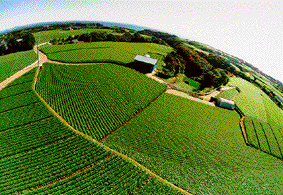
It is possible to make money on a purely vegetable farm, but the farming is amazingly intense making it virtually impossible to be long term sustainable due to the amount of resources removed from the land in produce versus what is given back from imported fertilizers. Much of the land is cultivated every 4-6 weeks for 8 months of the year leaving it exposed to erosion more often than it is covered. Furthermore, small vegetable operations often focus on niche markets like micro greens, herbs, edible flowers, etc and less on rows of spinach, radishes, beans or tomatoes that most vegetarians eat everyday. Even in Organic production the economies of scale favor industrial production of these ‘commodity’ items. And then you get into all the ecological messes inherent in large scale agriculture-massive soil erosion, processed fertilizers (like pelletized chicken manure), and long range transportation. Look at it this way: it takes a lot of radishes at $1.50 bunch to make the rent on a 40 acre farm ($350,000) farm. The fields of radishes at left is no ecologically better than a field of corn. The largest local vegetable operation I have visited was 30 acres, but it took a team of 5-10 workers 6 days a week to harvest the 200 CSA subscriptions and it was not profitable. Mixed vegetable operations for farmers markets are typically from much smaller farms, say 5-10 acres.

Last post I wrote about integrated farms-the kind of operation that virtually all farms were before 1950 and the rise of Industrial Agriculture. The bucolic scenes I painted of waves of different animals going over the vegetable field begged the question of where the heck the cattle, chickens, and hogs were prior to their dance thru the corn and melons. The answer is that the vegetable ‘fields’ are just one or two paddocks in a rotational grazing system as espoused by Allan Nation at the Stockman Grass Farmer, Jo Robinson at Eatwild.com, Gene Logsdon in All Flesh is Grass, and others. These are just a few of hundreds of farmers that are fine tuning the art of grazing to out compete the CAFO’s. I will spare you all the details-which are legion and beyond my expertise and present just a high level overview to give you an idea, if you want to learn more, as I feel any omnivore should, the Eatwild site is fairly user friendly.

Grass Farming

In my unhumble opinion Grass Farming is the future of farming. (I love that turn of phrase-the philosophical importance in the shift from calling oneself a Cattle Rancher to a Grass Farmer is immense.) By rotating grazing animals (yes, poultry and hogs graze!) through paddocks you greatly increase the holding capacity of the land. This is done by pulsing the pasture, much as the bison of old did. The farmer ‘mobs’ the field forcing the animals to eat everything, including the weeds, and then moves them to the next paddock before they can do any permanent damage from over grazing, while also keeping them there long enough to not just eat the tasty plants which encourages weed growth. The farmer keeps enough paddocks to rotate the animals while letting paddocks recoup, and this diversity also allows him to keep some paddocks sown with summer tolerant grass, and others with cold hardy varieties. There is even enough surplus in spring that the farmer can cut hay enough to tide them over thru the month or so of deep winter where the pasture may not be available. Other than moving the light electric fencing (easily run on solar) and animals daily the farmer can spend their energy on other areas like the vegetable patch or wood lot while the animals do the weeding, harvesting, and fertilizing for him. This is the animal husbandry equivalent of Masanobu Fukuoka’s “Do Nothing” rice farming: let nature do the work for you.

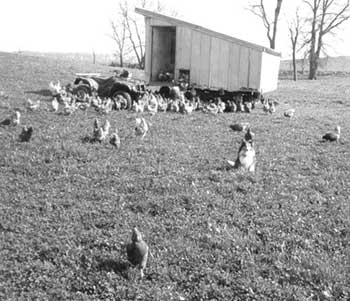
The reason that Grass Farming seems to me to be the holy grail of ecological eating is this: once the pasture is established, the land is never cultivated, never fertilized, never herbicided, and you can grass farm a small 20-40 acre farm without a tractor because the animals are doing most of the work. The farmer isn’t importing feed, or exporting waste-it is essentially a closed system. It works for beef and dairy operations, for goats, sheep or cattle, as well either broiler chickens or laying hens and with some tweaking I think hogs might work as well.

My main concerns with large scale agriculture are erosion from regular cultivation which also uses massive farm equipment, and the need to import resources-seed, fertilizer, and herbicide supporting a grossly polluting chemical industry. A grass fed animal system can literally grow calories 100% on solar power in a 1) closed system that 2) heals the soil (permanent pasture can make 750-1000lbs of topsoil a year) and actually 3) removes carbon from the atmosphere (some studies have shown that established prairie can capture as much carbon as the same acreage of hardwood forest). These 3 factors are something that growing annual vegetable crops cannot accomplish-even on small scale 2-5 acre farms. The only approximation I have read about would be a Permaculture Garden, which I have never seen presented in a workable commercial system. And frankly, if it isn’t profitable, at least enough to support a modest family income, it will never work in society as a whole.

21st Century Animal Farm

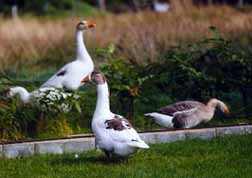
So here is my version of the Utopian Organic Farm-and it is not, nor could it be vegetarian. A 20-100 Acre plot divided into 15-30 paddocks containing everything from traditional pastures of alfalfa, clover and fescue, to fruit orchards, vineyards, brambles and 1-2 paddocks of vegetables grown on a rotating basis in paddocks that need replenishing. The pastures that are being put out of rotation next season would house the hogs which would tear them up sufficiently thru their rooting, while the orchards would be mown by sheep and geese, and the vineyards weeded by chickens. Dual purpose goats or cattle would graze thru the remaining pastures providing a surplus of both milk and meat to help make the mortgage along with the seasonal income of fruits from the perennial orchards and small fruit diversifying the farm’s income enough that a blight in the beans won’t bankrupt them. Costs would be kept down by having no, or a very small, tractor-and possibly just using some oxen (I am not kidding-most tractor use would only be for moving hay and harvest wagons) and no imported fertilizer. Efforts would be made to establish a local market that could meet many needs in one place-meat, dairy, fruit, veggies, eggs, and possibly even fiber from the goats or sheep. Niche markets could be established in artisan cheeses, goat milk soaps or heirloom vegetables for restaurants depending on the inclination of the farmer. A profitable agriculture enterprise is thus created (I realize how idealistic this is…) that is 100% solar driven on a closed system that builds community and cuts food transportation miles from 1500 to about 15. Joel Salatin is doing this on his farm and producing more surplus than I had ever thought imaginable off of 100 acres-so maybe I am not too crazy after all.

I am becoming convinced that Organic 100% Grass Fed meat and eggs, along with perennial fruits are the ecological ideal. And that blows massive logical holes thru my stance on vegetarianism for ecological reasons. In the final post in this series I will wrestle with that.

Labels: , ,

Stumble Upon ToolbarStumble It!

Monday, November 13, 2006

Eco Vegetarianism Part II

Here is the second installment on my delving into the perhaps weakening factual basis for my eco/sociological vegetarianism. If you are an Ethical Vegetarian, or Gaia help me… a Vegan, you will find little to agree with here, and possibly even become spitting mad, because we are starting from different ethical worldviews. Personally, though I do not find killing animals for my food pleasant, I also feel that humans are omnivores and I have no moral objection to eating meat. So for the curious among all groups, please read on.

In our quest to reduce our ecological footprint, and eat healthier to boot, we have spent muchenergy attempting to eat as local as possible. This trend has gotten us out to talk to several more farmers and tour their farms. All of this keeps pointing me to one conclusion: that farms work best, maximising yield and minimising inputs, with an integrated relationship is fostered between plants and animals. Our grandparents knew this to be self evident, Permaculture espouses it, and nature wouldn't function any other way. The best way to cycle nutrients on a farm is to use our microbial friends (soil and compost) and animals to make nutrients available in a form that plants can use to create surplus calories from the sun which can then feed us humans and the animals. It’s a nice tidy system. Without animals on the farm, you invariably need to import fertilizer or organic matter to make the needed tons of compost, incurring transportation costs and burning more fuel. And even then, raw manure, especially urine, is still the best fertilizer. By splitting the system we are wasting energy to poorly mimic what nature will give us for free.

Permaculture gardening stacks vegetables in tightly to grow as many calories in as little acreage as possible to maximize yields and minimize inputs. One can grow corn, melons, and beans in the same area you could grow any one of the three and drastically increase your yield. Taking some of the learning’s I am getting from Permaculture, Joel Salatin, and Gene Logsdon I am beginning to think there is an even better way. Taking this out another step you can run geese thru the field while it is in production to eat slugs and weeds, and then post harvest run cattle or goats through to eat the roughage we can't-increasing the yield of edible calories. But we aren’t done yet, while the cattle are in send in chickens and they will graze on weeds, eat insects, and keep the cows healthier by eating parasites out of their manure. Before you’re done send the swine thru to churn up the whole works for next year while they eat grubs and other pests. All four will add healthy quantities of manure (cows as much as 50lbs/day each) to replenish the soil with zero petrochemicals spent in processing or transport. Animals make sense on a farm, or even in the garden, as they increase on site resource use, food production, and cut back on imported resources: keeping it local and closing the resource loop.

The cold truth is that farms don’t make a lot of money-they never have and they never will. That means, unless you are living off grants or subsidies, every single item on a farm needs to make money-and the more ways the better. This also means that you can’t afford to keep geese just to eat slugs-you also need to eat/sell the meat to make up for the added expense of their housing and care. Dairy cows (interchange goats as needed) once seemed like a great vegetarian alternative to me as you could make money off of them without the whole blood and gore piece. But this just proves that I am an ignorant city slicker-and a male one to boot. Why do cows give milk? Same reason all mammals do-to rear their young. That means that once a year you need to “freshen” the cow through having her “throw” a calf and then keep her in lactation for the rest of the year after you wean off the calf. If that calf is a heifer-great! You just expanded your herd. If it’s a steer or if you don’t need any more dairy cows, well it gets raised for meat. Some farmers, like Gene Logsdon, will raise those calves all year on pasture and sell them in the fall as grass fed Baby Beef-very different than a veal calf raised in a 16 sq ft pen all its very short life. This fact has pushed Mia even closer to giving up dairy completely. There really is no way around this-no one really keeps cows for pets-too darn expensive.

Egg laying chickens are better, they are much more feasible for the gardener as a small flock is inexpensive, relatively low maintenance, and apparently their egg production goes on regardless of breeding. I have read of numerous families treating these chickens as pets, and burying them out behind the Oak tree by Mildy the Cat when their days are done. But for a money making enterprise you need a lot of chickens. Organic Valley won’t even pick up your eggs unless you have over 2000 birds (though this is manageable on as little as 4 prime acres), and that is a lot of chicken graves to dig. More likely you will sell them for low quality meat after they have lived out their egg laying lives because now you need to extra revenue to pay for all that extra fencing, feed, medication, and housing. The long and short of it is that unless you are raising animals for show, the only way to have most animals on a farm is to raise them, at least in a final gasp of revenue, for meat.

This is not to say that I think of all things on a cost benefit analysis, but with arable land prices in much of the country escalating past $3000/acre, and here in WI at more than $5000/acre if we want small family farms to succeed they simply must be profitable-and nothing on a farm will make as much money with as little effort (read family-not corporate- farm) as integrated, diversified livestock management alongside a vegetable and grain/pasture operation.

In all of the above I am utilizing Natural Capitalism, and accounting for the real costs of things like effluent flows from Concentrated Animal Feeding Operations (CAFO’S) at right, transportation from buying your cattle feed from Argentina because its “cheaper”, or in dumping petrochemical fertilizer onto your field to increase yields while destroying the soil. You can make money off land that way, even at $3-5000/acre, but you are forcing future generations to foot the environmental bill-which should be criminal. Plus that is not the kind of farming I want to save anyhow. From one point of view farmers are artisans, combine operators are drivers, and CAFO operators just might be Evil.

If I became a vegetarian to reduce my ecological footprint it is becoming more clear that what I am protesting was not meat-but the eff’d up way that we are raising meat-growing the food thousands of miles from the cattle, and then forcing the cattle into CAFO’s to create massive effluent issues and intolerable living conditions. The degradation of energy argument losses some momentum if the energy being degraded was never in a form humans can consume-like fouled melons or corn stalks.

As I said in the beginning, raising meat humanely and offering the animal a clean death is not morally wrong to me. What we do to animals in CAFO's makes me fighting mad and want to join PETA. This bears thought.

Labels: , ,

Stumble Upon ToolbarStumble It!

Sunday, November 12, 2006

Eco Vegetarianism: no free lunch.

The kicker about become Eco Aware is that you lose ignorance. Things as simple as eating and driving can become moral choices. And the choices are never nice and tidy. My current issue is food... my vegetarianism in particular.

Mia and I have been virtual veggies for years, getting more and more hardcore until the past 2 years Mia has been all but 100%-only very rarely breaking ranks to avoid being rude when we are eating at friends or family with myself about 98%. While we both eat very similarly, we do so for different reasons. I started eating less meat for ecological reasons-I want to eat lower on the food chain to reduce the amount of acreage it takes to feed me fat arse. Mia is all about the ecological side as well, but is also an Ethical Vegetarian-she believes that killing an animal for her own food is wrong. Not to mention she has an at times irrational repugnancy to turkey necks and chicken feet. I credit her greatly for stopping well short of condemning others for not doing so-its a personal choice for her.

So I sat safely ensconced in my ideals for several years, but my recent rash of agricultural reading is shaking my convictions. The acreage argument is still wicked strong. Drive I-80 across Iowa and you will see farms for 800 miles, and nary a single plant that humans can eat. Corn on Beans for mile after mile. The ecological impact of that much genetically modified monoculture is unprecedented. Erosion alone is averaging over 5 tons per acre per year to the extent that the silt field in the Gulf of Mexico is visible from space. But as I research large scale organic agriculture the more I am convinced that industrial anything is unsustainable. So we have switched to mostly local foods grown on small Wisconsin farms using the European slogan of Eat Your View as a motto and cutting about 1250 miles off the transport of much of our food in the process.

This is much better, but my resolve is weakening. The more I read about small scale agriculture, the more farms I tour, and the more books on Permaculture I research-the more I think that a vegetarianism based on pure ecological grounds is misplaced. So as is my wont, I'd like to explore these thoughts in a series of posts.

Stay tuned!

Labels: , ,

Stumble Upon ToolbarStumble It!

Thursday, October 26, 2006

Future of Farms

I have blogged at length on the future of farming. I see it vividly every week at the Madison Farmers Market and at our local CSA. I saw it in depth at Michael Field's Institute when I worked there a few summers back. The future of farming is smaller and more intimate-I think of a well run organic micro farm as a den lined with well thumbed tomes to Con Agra's multimedia room with its 72" flat screen. That 'future' is happening now all across the coasts and in the upper Midwest. But the farms it is happening on are run by established farmers who have either 'seen the light' or never stepped into the darkness in the first place.

But what about the rest of the farms-the remaining good ones? Last week Mia, the kids and I were invited out to tour a local sheep farm that is run by an older couple that is attending the Natural Step study group I am in. The farm is breathtaking-like an agricultural time capsule from 1940. Turning into their gravel lane we were greeted by a mated pair of Sandhill cranes feeding not 20 yards off to our right. Then our eyes drifted up to the barnyard: not a single metal building-all red painted wood plank barns and sheds with field stone foundations-freshly painted with solid roofs. A working farm, and it looks like a Vermont postcard. The farmhouse is smallish-probably under 1400sq ft, and is nestled against an east facing hillside to protect it from winter winds. We climbed that hill behind the house to get a look around. The farm itself is divided into 3 "40's" with another 25 or so broke off for the pond which is set aside for the cranes and migrating birds-the sheep are not allowed access. The first and second 40 use the ridge line of the hill as a dividing line, with the 3rd 40 divided off by a 20 yard thick mature windbreak that also borders the preimeterof the property. From the barnyard you can see neither road nor house. The first two 40's are dotted with bleating white puff balls that surge over as we approach-each a herd of 50 sheep-the lambs in one and the ewe's in the other. From the crest of the hill we can see the second pair of Sandhills that trusts the farm enough to raise their young on it as well as a hundred or so waterfowl in the distant pond.

Our friends are not young people, though I doubt I could keep up with him for a day-in-the-life. Having worked in the factories of Milwaukee for over 40 years before retiring to run a farm for another 18, they deserve their rest, but will need income or at least liquidation to achieve it. It does not appear that their children are interested, so this farm could be on the market within a matter of years. This area is becoming less rural by the month-my backyard was farmed 30 months ago. There aren't a whole lot of comps up right now, but I figure $5-6k per acre-and they have 143. Round it down to an even $750,000-but this is not including the structures. Current income for the land is about $20k plus whatever they are getting for the 70 acres they rent out. Mortgage on $750k is roughly $6k per month. Granted the land is underutilized now, but I am fairly sure it could not support a herd of 500 sheep-and a herd that big would mean hiring help-cutting into margins. An organic dairy operation would work, but most likely it would be sold to one of the large local corn/bean farmers who will cut the windbreaks, plow under the pasture and plant corn up to the EPA limit on the pond despite the fact that the small (50 head) dairy operation would be more profitable.

We live in a hub of organic agriculture-within an hours drive of a critically acclaimed Biodynamic Farming Institute that seeds the state with a few dozen new graduates a year. These kids work hard, have amazing ideas...and no money. Try talking a bank into loaning you $750k for a biodynamic farm and you will be thrown out on your biodynamic ass. Plus it took 10-20 workers to keep the 30 acre CSA I worked on running. A 140 acre CSA would be a Big Business employing dozens and taking millions in capital. Not within the scope of your average 23 yr old hippie. The dairy would work, but again the loan is the stopping point. The Farmer will have to hit the ground running a business capable of grossing $100k the first year, and repeat that every year for 30 more or they will literally "lose the farm". I can here the dirge of "Corn on Beans! Corn on Beans!" looming patiently in the background until I quit whining about biodynamic dreams so it can set in with fiscal reality.

I don't know what options that this generation of small farmers have, but the reality of our shrinking rural landscape is testament to the results of the more common solutions.
I am an optimist. There has to be a better way-a Land Trust would be a good start but there isn't enough money in them to save them all.

Anyone want to start a Co-op? I'll drive the tractor and you can brew the biodiesel.

Labels:

Stumble Upon ToolbarStumble It!

Tuesday, October 03, 2006

Ecomunicipality Update

October's Green meeting was last night. The agenda was long, but we had some big items up. first of all we got the Stormwater Mapping Grant! This will give us over $100k to hire a consultant to map the historical water flows of the village, as well as the current flows. This will give us hard concrete data on future planning for infiltration vs retention ponds, past developments effects on the watershed and hopefully allow us to start backcasting to get ensure our future looks more like our past-and limit our impact to the watershed. One of the coolest possibilities of this grant is the implementation of a Stormwater Utility. With the data in hand we can look into assessing a monthly fee to landowners based on the amount to runoff from their property. When Big Box Retail comes to town, they will now have a monetary incentive to invest in infiltration ponds, large scale rain gardens on the edges of buildings, etc. Is this big? YES!

Also on the docket was a discussion of the forthcoming LEED-H green building standards vs the current Energy Star ratings. The discussion boiled down to 2 groups of arguments. Energy Star is an existing, accepted standard that at least one large local builder is currently using drastically increasing the ease of convincing other developers and future home buyers of the advantages. On the flip side LLED H is still in pilot and up until now has focus on larger commercial and government building projects-the average home-buyer will not have a working knowledge of it and will need some education to appreciate the advantages. Also Energy Star is focused on maximising the current building code, and then stacking the house with more efficient appliances-still working within the current building paradigms and achieving an important, but not huge 15% efficiency increase. LEED, however starts breaking out of the box with its focus on site selection, use of recycled building materials, reduction of waste in the building process, focusing on environmentally friendly landscape design, total house size and a myriad other items. Put another way, if you scroll down to page 21 to find the LEED H ratings checklist you will see that a Silver rated home must achieve 50 points-and building an Energy Star certified home will only earn you 16 points! LEED is a much more holistic design philosophy. In the end we have chosen to pursue the LEED standard, and as a first step we are initiating discussions with the 'greenest' (different than Green) builder in the area to begin the road to them entering in Leeds Pilot Program.

Look for more updates as we get closer to rolling out the Residential Building Standards in 2007!

Labels:

Stumble Upon ToolbarStumble It!